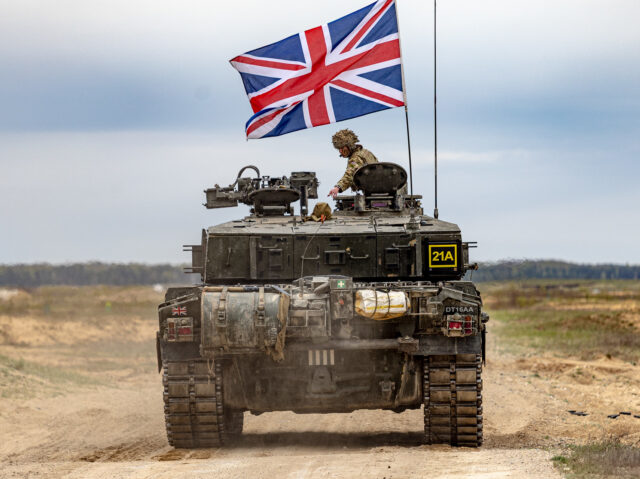

A former Secretary General of NATO breaks cover to blow the whistle on “non-military experts in the treasury” vandalising Britain’s military and the “corrosive complacency” that rules in Westminster, which is leaving the country’s security in a “parlous state” and its safety “in peril”.
The veteran Labour politician who wrote Prime Minister Sir Keir Starmer’s Strategic Defence Review (SDR), who was the head of the NATO alliance between 1999 and 2003, who had been Tony Blair’s defence minister before then, and who by his own account has been working “constructively behind the scenes” to try and fix Britain’s defence disaster is said to have “run out of patience”. The Financial Times reports in advance of a scathing speech Lord Robertson is due to give today in which he is to expose the disarmament of Britain he has attempted to stem, and evidently feels he has failed to prevent, from the inside of government.
Separately, General Sir Richard Barrons — who worked with Robertson as a co-author on the government’s Strategic Defence Review, published to great fanfare last year but apparently immediately forgotten — spoke to Britain’s state broadcaster the BBC this morning to say he “completely” agrees with the criticism of the government. General Barrons told Radio Four: “I think it’s a mark of how serious it is that someone who has been a Labour Party activist for more than 60 years and was a NATO secretary-general has now had to say it in these terms today.”
While insiders have been sounding alarm on the state of Britain’s defence for decades, these warnings have generally found themselves without an audience. The longstanding wisdom in Westminster is “there are no votes in defence” and when it comes down to selling policy to the public, on the “guns versus butter” scale, butter always wins. Yet that is suddenly changing: the money-saving but risky strategy of occasionally retiring a British military capability and leaving it inactive for a few years before commissioning its replacement has now coincided with a global crisis where that capability-gapped equipment is needed, and this played out before a global audience seeing the former gunboat diplomacy nation stripped bare.
Bruisingly for Britain, many have noticed this glaring issue. In the United States President Donald Trump — who has made no pretences about his deep disappointment in Britain’s unwilling and inability to contribute to global security — and his Secretary of War Pete Hegseth both grimly mocked the state of the Royal Navy in recent weeks. General Barrons spoke of this today, saying that while it hurt him to hear it, he couldn’t contradict it.
He told Radio Four: “I hung my head in sorrow but I couldn’t argue with him because although the Royal Navy, Royal Air Force and Army are in their bones outstanding institutions, they are simply too small and too undernourished to deal with the world that we now live in”.
All of this shows how the country’s state of defence is “parlous”, Lord Robertson is reported to be saying today, warning Britain is “in peril” and its military simultaneously facing crises in fighting equipment, logistics, engineering, cyberwarfare, ammunition, training, and military medicine. This is in part down to the “corrosive complacency” of “Britain’s political leadership” and the “vandalism” of “non-military experts in the Treasury”.
Indeed, it is not clear exactly how large the financial crisis facing Britain’s armed forces actually is. The Ministry of Defence hasn’t published an annual investment plan in years and the present Defence Investment Plan (DIP), which is meant to explain how the government will fund the changes and military growth called for in last year’s SDR is being repeatedly delayed. It seems almost certain there is a tens of billions “black hole” of a gap between the even modest military plans the government has and what it’s willing to spend: it is widely claimed in Whitehall that the DIP is delayed because the Treasury simply refuses to release any money.
The United Kingdom’s defence budget for the present financial year is £62 billion. The welfare budget is £216 billion in that same year, about a third of the whole government budget. As things stand, the British government spends roughly the cost of one new frigate for the Royal Navy every month on cash welfare payments to migrant households.
Clearly taking aim at this disparity, Lord Robertson said in his trailered comments: “We cannot defend Britain with an ever-expanding welfare budget”.
The United Kingdom is in a now years-long process under several governments, both Tory and Labour, of talking big on defence while at the same time starving the military of the funding required to do the job. Morale among those few still in the armed forces is said to be low and recruitment has been at crisis level for decades: thanks in part to poor conditions and an uncompetitive pay offer that sees British troops paid a fraction of those doing comparable jobs elsewhere. As reported earlier this year:
Britain’s Chancellor of the Exchequer (finance minister) Rachel Reeves has ruled out the possibility of a boost to defence spending this year, stating the Ministry of Defence will have to wait for “future spending reviews”. While NATO’s best performing members — such as Poland — push their spending upwards in line with the leadership of President Trump calling for treaty signatories to dedicate five per cent of GDP to defence, the denial of a cash boost makes certain the British military won’t make it to three per cent in the life of this government.
The Treasury department expressed concern about wasteful spending in the Ministry of Defence… While the decision to not make extra discretionary spending on growing the military may seem rational for a country which is not at war and which operates a considerably and decades-long government budget deficit, it does clash conspicuously with the actual rhetoric of the government. The Prime Minister himself, Sir Keir Starmer, spoke stridently just this past weekend at the Munich Security Conference of the need for military might.
Another round of bellicose rhetoric with no extra spending or capability attached arrived last week, with Britain’s Chief of the Defence Staff Air Chief Marshal Sir Richard Knighton stating the Ministry of Defence is working on a plan to transition the whole of society to war, Sky News reported. The government maintained such a plan, called the Government War Book, through the Cold War: a detailed and itemised list of acts to be taken in case of a sudden attack to bring every part of the nation under the control of the state and redirect it towards total war.
The old war book involved not just mobilising the military and dispersing the government to remote underground sites in hope of surviving a surprise decapitation strike, but also taking industry, the economy, and all arms of the state in hand to direct their efforts, as had been the case during the First and Second World Wars, when a market economy and individual liberty were all but suspended.
COMMENTS
Please let us know if you're having issues with commenting.